
Burnout vs. Occupational Wellness: Know the Difference
Struggling to tell burnout from ordinary work stress? Learn the key differences, warning signs, and how to rebuild occupational wellness.
CORPORATE WELLNESS
7/21/20264 min read


"I'm just tired" is one of the most dangerous sentences in modern work life — not because it's untrue, but because it can mean two very different things. Sometimes it's ordinary fatigue that a good weekend fixes. Other times, it's the early language of burnout, a state that doesn't resolve with rest alone and tends to get worse the longer it's dismissed as normal.
Understanding burnout vs. occupational wellness isn't just semantics. One is a warning sign that something in your relationship with work has broken down. The other is a state you actively build and maintain. Confusing the two — or worse, not realizing there's a difference — is exactly how minor exhaustion turns into a full breakdown that takes months to recover from.
What Occupational Wellness Actually Means
Occupational wellness is often reduced to "liking your job," but it's more specific than that. It's the sense that your work is sustainable — that it aligns reasonably well with your values, that you have some control over how you do it, that your effort is recognized, and that your job leaves you with enough energy to actually live the rest of your life.
People with strong occupational wellness still have hard days. They still get frustrated, miss deadlines, or dread certain meetings. The difference is that these moments are exceptions inside a system that's fundamentally working — not the daily baseline.
Occupational wellness rests on a few consistent pillars:
Autonomy — having some say in how your work gets done, not just what gets done
Recognition — feeling that effort and results are actually seen
Boundaries — being able to switch off without guilt or fear of consequences
Alignment — believing the work connects to something that matters to you
Manageable demand — a workload that stretches you without permanently overwhelming you
When most of these are intact, stress stays situational. When several are chronically missing, that's usually when burnout starts to take root.
What Burnout Actually Is
Burnout isn't just "being really tired from work." It's a specific, recognized state of physical and emotional depletion that develops from prolonged, unresolved workplace stress. It typically shows up in three distinct ways:
1. Emotional exhaustion — feeling completely drained before the day has even properly started, with nothing left to give by mid-afternoon.
2. Cynicism and detachment — a growing emotional distance from work that once mattered to you. Colleagues start to feel like obstacles. Tasks that used to feel meaningful start to feel pointless.
3. Reduced sense of accomplishment — a persistent feeling of being ineffective or inadequate, even when your actual output hasn't changed.
Crucially, burnout doesn't appear overnight. It builds gradually, often while someone keeps performing at a high level externally, which is exactly why it's so easy to miss until it's severe.
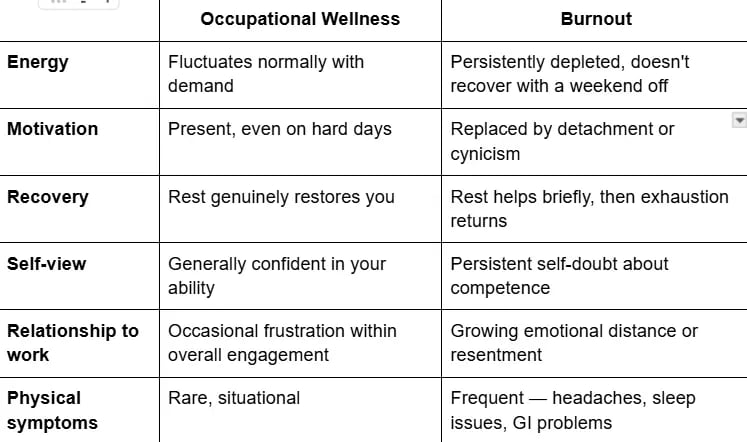
The Core Differences: Burnout vs. Occupational Wellness
The most useful diagnostic question isn't "am I tired?" — almost everyone with a demanding job is tired sometimes. It's "does rest actually fix it?" Ordinary fatigue responds to sleep, a weekend, or a lighter week. Burnout doesn't. You can take a full week of vacation and come back just as depleted as you left, because the problem isn't a lack of rest — it's a mismatch between what your job demands and what's actually sustainable for you.
Why the Line Gets Blurry
Part of what makes burnout vs. occupational wellness genuinely hard to distinguish is that burnout often hides behind competence. High performers, in particular, tend to push through the early warning signs precisely because they're good at compensating — working longer, caring more, holding standards higher — right up until the compensation itself becomes unsustainable.
Workplace culture makes this worse. In environments where busyness is treated as a badge of honor, the early signs of burnout — irritability, disengagement, dips in enthusiasm — get relabeled as "just a rough patch" or "needing to toughen up," instead of being recognized as legitimate warning signals worth addressing.
Warning Signs Worth Taking Seriously
A few signals tend to show up before burnout becomes severe, and catching them early makes recovery significantly easier:
Dreading the start of the workday, even before anything has gone wrong
Needing increasing amounts of caffeine or stimulation just to function at a baseline level
Physical symptoms — tension headaches, stomach issues, disrupted sleep — with no other clear cause
Feeling emotionally flat about achievements that would once have felt satisfying
Withdrawing from colleagues or avoiding collaboration you used to enjoy
A creeping sense that nothing you do actually makes a difference
None of these individually confirm burnout. Together, and sustained over weeks rather than days, they're a strong signal that occupational wellness has broken down and needs active intervention — not just a long weekend.
Rebuilding Occupational Wellness After Burnout
Recovering from burnout isn't just about working less — it's about restoring the specific pillars that broke down in the first place. That often means renegotiating workload rather than just pushing through it, rebuilding a sense of control over how work gets done, and reconnecting with what originally made the work feel meaningful.
It also means recognizing that burnout rarely stays contained to work. Left unaddressed, it tends to spill into sleep, relationships, and physical health — which is exactly why occupational wellness can't be treated as a standalone box to fix in isolation. Sustainable recovery usually involves looking at the full picture: how work stress is affecting sleep, mental health, and daily habits, not just the job itself.
Burnout vs. occupational wellness ultimately comes down to a simple test: does rest actually restore you, or does the exhaustion return no matter how much time off you take? Ordinary work stress is uncomfortable but temporary. Burnout is a deeper depletion that builds quietly, often while you're still performing well on the surface — which is exactly why it deserves to be taken seriously the moment the early signs appear, rather than dismissed as just needing to push through.
Stay Connected
Reach out for personalised healthcare and wellness solutions. We are building in Bhubaneswar first - gym owners, wellness professionals, and individuals welcome.
Phone
contact@hiwox.com
+91-9876543210
© 2026. All rights reserved.
Resources